
The e-commerce industry continues to grow rapidly, creating exciting opportunities for aspiring entrepreneurs. More consumers are shopping online than ever before, making it easier for businesses to reach customers without the high costs associated with physical stores. Whether you want to sell physical products, digital products, or offer subscription services, the online marketplace provides countless possibilities for growth.
Now is an excellent time to start an E-Commerce Business from Scratch because modern tools have made launching an online store more affordable and accessible. E-commerce platforms, payment gateways, and digital marketing channels allow beginners to build and scale a business with minimal upfront investment. Instead of requiring a large team or significant capital, many successful online businesses start with a single product and a clear strategy.
In this guide, you’ll learn how to choose a profitable niche, identify product opportunities, select the right business model, and build a strong foundation for long-term success. By following these proven steps, you can confidently enter the world of e-commerce and create a profitable online store.
What Does It Mean to Start an E-Commerce Business from Scratch?
To start an E-Commerce Business from Scratch means building an online business from the ground up without an existing customer base, inventory system, or brand presence. It involves identifying a market opportunity, creating an online store, attracting customers, and generating revenue through digital sales channels.
✓ E-Commerce Launch Checklist
Make sure these essentials are completed before launching your online store.
Business Name Chosen
Select a memorable brand name and secure it across platforms.
Domain Registered
Purchase a professional domain that matches your brand.
Products Added
Upload products with clear descriptions and pricing.
Payment Gateway Ready
Enable secure online payment options for customers.
Shipping Configured
Set shipping rates, delivery zones, and tracking options.
Mobile-Friendly Design
Ensure the store works perfectly on smartphones.
SEO Basics Completed
Optimize titles, meta descriptions, and product pages.
Analytics Installed
Track visitors, sales, and customer behavior.
What Is an E-Commerce Business?
An e-commerce business is a company that sells products or services online. Unlike traditional retail stores, e-commerce businesses operate through websites, online marketplaces, or mobile apps. Customers can browse products, place orders, and complete payments digitally. Popular examples include online clothing stores, electronics retailers, subscription box services, and digital product marketplaces. The flexibility of online selling allows businesses to serve local, national, or global audiences.
New to E-Commerce? Start Here!
If you’re completely new to online selling, our beginner-friendly guide will walk you through the fundamentals of e-commerce, business models, website setup, product selection, and marketing strategies.
Beginner Friendly Guide to E-commerce →How E-Commerce Businesses Generate Revenue
E-commerce businesses generate revenue by selling products or services directly to customers online. Revenue can come from physical goods, digital downloads, memberships, subscriptions, affiliate partnerships, or recurring service plans. Profitability depends on factors such as product pricing, operating costs, customer acquisition expenses, and conversion rates. Successful online stores focus on attracting targeted traffic, optimizing product pages, and delivering excellent customer experiences to maximize sales.
Different Types of E-Commerce Models
Several e-commerce models cater to different business goals. Business-to-Consumer (B2C) stores sell directly to individual customers, while Business-to-Business (B2B) companies serve other businesses. Other popular models include dropshipping, print-on-demand, private labeling, and inventory-based retail. Choosing the right model depends on your budget, product type, and long-term growth strategy.
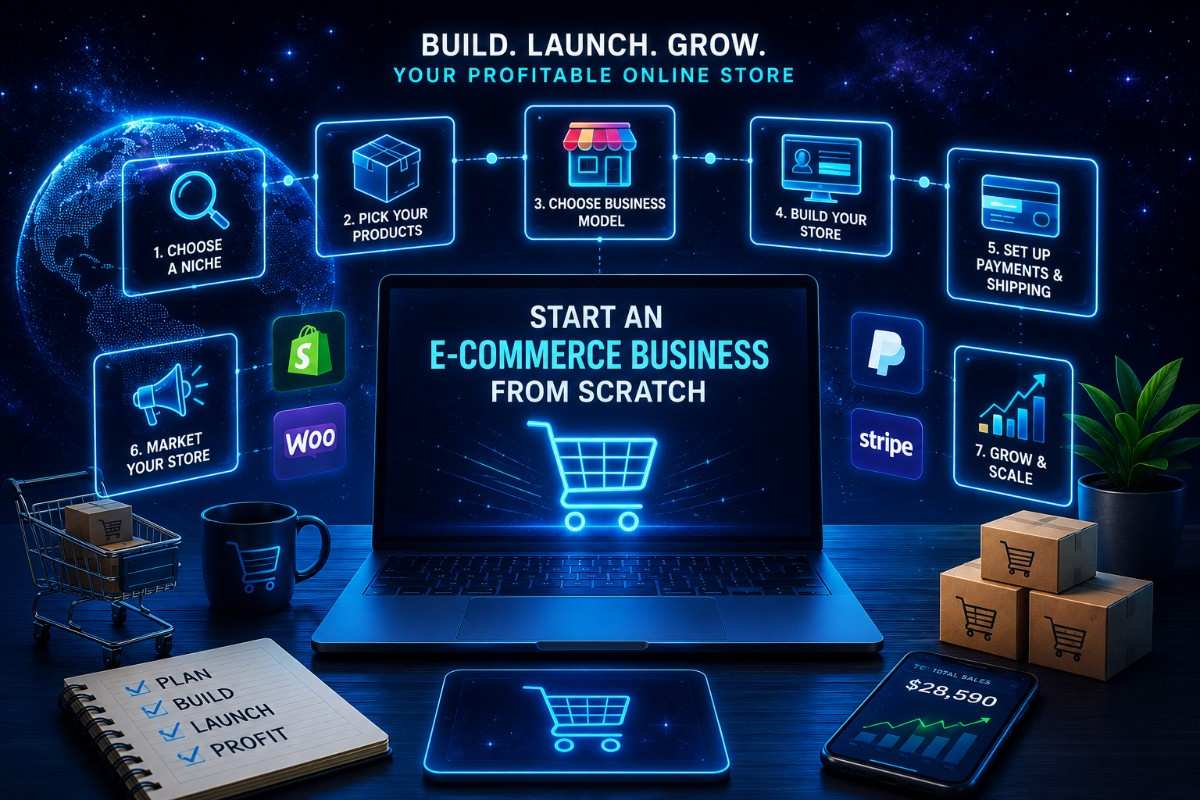
Start an E-Commerce Business from Scratch in 7 Simple Steps
Choose a Niche
Find a profitable market with strong demand and growth potential.
Select Products
Choose products that solve customer problems and offer healthy margins.
Pick a Business Model
Dropshipping, private label, print-on-demand, or inventory-based selling.
Build Your Store
Create a professional, mobile-friendly e-commerce website.
Set Up Payments
Enable secure payment gateways and configure shipping options.
Market Your Business
Use SEO, content marketing, social media, and paid advertising.
Scale & Grow
Optimize conversions, retain customers, and expand product lines.
Why Starting an E-Commerce Business Is a Smart Idea in 2026
Entrepreneurs continue to choose e-commerce because it offers lower barriers to entry, greater flexibility, and significant growth potential. As online shopping becomes increasingly integrated into everyday life, launching an online business can be a practical way to build a sustainable income stream.
Ready to Launch Your Online Store?
Now that you understand the fundamentals of starting an e-commerce business, it’s time to follow a proven step-by-step roadmap. Learn how to choose products, build your store, attract customers, and grow a profitable online business from scratch.
How to Start an Ecommerce Business →Low Startup Costs Compared to Traditional Businesses
Traditional businesses often require expenses such as storefront rent, utility bills, furniture, and large inventory investments. In contrast, many online stores can be launched with a website, domain name, and a small marketing budget. Business models like dropshipping and print-on-demand further reduce costs by eliminating the need to hold inventory. This affordability makes e-commerce an attractive option for beginners and small business owners.
Access to a Global Customer Base
One of the greatest advantages of e-commerce is the ability to reach customers worldwide. Unlike physical stores limited by geography, online businesses can market products across multiple regions and countries. Through search engine optimization, social media marketing, and paid advertising, businesses can attract qualified buyers from diverse markets and expand their customer base over time.
Flexible and Scalable Business Model
When you start an E-Commerce Business from Scratch, you gain the flexibility to operate from virtually anywhere with an internet connection. As your business grows, scaling becomes easier through automation tools, digital marketing campaigns, and streamlined fulfillment processes. You can introduce new product lines, expand into additional markets, and increase revenue without the limitations typically associated with traditional retail businesses. This scalability makes e-commerce one of the most attractive business opportunities for entrepreneurs in 2026.
Want to Understand How an E-Commerce Business Really Works?
Before building your online store, it’s important to understand the different types of e-commerce businesses, how they generate revenue, and which model best fits your goals. Learn the fundamentals and choose the right path for long-term success.
Ecommerce Business: Complete Beginner’s Guide →Step 1: Choose a Profitable E-Commerce Niche
Selecting the right niche is one of the most important decisions you’ll make when you start an E-Commerce Business from Scratch. A profitable niche helps you attract a specific audience, differentiate yourself from competitors, and build a sustainable brand.
What Makes a Good Niche?
A strong niche combines market demand, profitability, and long-term growth potential. Ideally, it should solve a problem, fulfill a need, or cater to a passionate audience. Niches with dedicated customer communities often offer better opportunities for repeat purchases and brand loyalty. Avoid markets that are too broad or excessively competitive when starting out.
How to Find Profitable Product Opportunities
Begin by researching trending products, consumer interests, and emerging market demands. Explore online marketplaces, social media platforms, industry forums, and keyword research tools to identify opportunities. Look for products with consistent demand rather than short-lived trends. Consider factors such as profit margins, shipping requirements, competition levels, and customer interest before making a final decision.
Research Competitors Before You Launch
Competitor research helps you understand what is already working in your target market. Analyze competitor websites, product offerings, pricing strategies, customer reviews, and marketing tactics. Pay close attention to gaps in their services or customer complaints, as these can reveal opportunities for differentiation. Learning from competitors can help you avoid common mistakes and refine your business strategy.
Validate Market Demand
Before investing significant time and money, validate that customers are willing to buy your products. Use keyword research tools to assess search volume, review online discussions, monitor social media engagement, and test product ideas with small advertising campaigns. Pre-orders, surveys, and landing pages can also provide valuable insights. Validating demand reduces risk and increases the likelihood of building a profitable online store.
Step 2: Decide What Products to Sell
Choosing the right products is one of the most important decisions when launching an online store. The products you sell directly affect your profit margins, marketing strategy, customer acquisition costs, and long-term growth potential. Successful e-commerce businesses focus on products with consistent demand, manageable competition, and a clear target audience. Before selecting a product category, consider factors such as market demand, shipping costs, customer needs, and scalability.
Physical Products
Physical products are tangible goods that customers purchase and receive through shipping or local delivery. Examples include clothing, electronics, beauty products, home décor, fitness equipment, and pet supplies. This is one of the most common e-commerce business categories because consumers are comfortable shopping for physical items online. While physical products often offer strong revenue opportunities, they may require inventory management, warehousing, packaging, and fulfillment processes. Choosing products with healthy profit margins and recurring demand can significantly improve long-term business success.
Digital Products
Digital products are items that customers can download or access online instantly after purchase. Common examples include eBooks, online courses, templates, software, stock photos, digital planners, and membership content. Digital products are attractive because they eliminate inventory costs, shipping expenses, and fulfillment challenges. Once created, they can be sold repeatedly with minimal ongoing costs. Many entrepreneurs choose digital products because they provide scalable income opportunities and high profit margins while allowing businesses to reach customers worldwide.
Subscription-Based Products
Subscription-based businesses generate recurring revenue by charging customers on a weekly, monthly, or annual basis. Examples include subscription boxes, software subscriptions, premium content memberships, and recurring product deliveries. This business model creates predictable cash flow and improves customer retention. Instead of relying solely on one-time purchases, businesses can build long-term relationships with customers through continuous value delivery. Subscription models are especially effective in industries such as beauty, health, education, software, and lifestyle products.
Handmade and Custom Products
Handmade and custom products allow businesses to differentiate themselves in competitive markets. These products may include personalized jewelry, handcrafted gifts, artwork, custom apparel, home décor, and specialty items. Customers often pay premium prices for unique products that cannot be found in mass-market stores. Selling handmade products also helps establish a strong brand identity and customer loyalty. However, production capacity and fulfillment timelines should be carefully managed to ensure a positive customer experience.
How to Choose the Right Product Category
The best product category aligns with customer demand, your interests, and profitability goals. Start by researching search trends, customer pain points, and market opportunities. Evaluate competition levels, average selling prices, shipping requirements, and potential profit margins. Focus on solving specific customer problems rather than simply following trends. A successful online store often starts with a targeted niche before expanding into related product categories. By validating demand and understanding your audience, you can select products that support sustainable business growth.
Step 3: Select the Best E-Commerce Business Model
An e-commerce business model determines how products are sourced, managed, and delivered to customers. Choosing the right model affects startup costs, operational complexity, profit margins, and scalability. Understanding the advantages and limitations of each model can help you build a business that aligns with your budget and long-term goals.
Dropshipping
Dropshipping is one of the most beginner-friendly e-commerce business models. Instead of storing inventory, you partner with suppliers who ship products directly to customers after an order is placed. This reduces upfront investment and inventory risk. Because you do not manage warehousing or fulfillment, dropshipping allows you to focus on marketing, customer service, and store growth. However, lower profit margins and limited control over shipping and product quality can present challenges.
Print-on-Demand
Print-on-demand allows entrepreneurs to sell custom-designed products without holding inventory. Products such as T-shirts, mugs, phone cases, tote bags, and posters are printed only after a customer places an order. This model eliminates inventory costs and provides creative flexibility. It is particularly popular among designers, influencers, and content creators looking to monetize their audience. Success often depends on strong branding, unique designs, and effective digital marketing strategies.
Private Labeling
Private labeling involves sourcing generic products from manufacturers and selling them under your own brand name. This model provides greater control over branding, pricing, and customer experience. Private-label businesses often achieve higher profit margins because they create unique brand identities rather than competing solely on price. While this model requires a larger upfront investment, it offers significant opportunities for long-term growth and customer loyalty.
Wholesale E-Commerce
Wholesale e-commerce involves purchasing products in bulk from manufacturers or distributors and reselling them at a markup. Buying inventory in larger quantities often reduces per-unit costs and increases profit potential. Wholesale businesses benefit from predictable product availability and greater inventory control. However, they require higher startup capital and effective inventory management systems to avoid overstocking or stock shortages.
Inventory-Based Selling
Inventory-based selling is a traditional retail approach where businesses purchase, store, and manage their own products. This model provides complete control over product quality, packaging, shipping, and customer experience. Although inventory management requires additional resources and storage space, it can support higher profit margins and stronger brand consistency. Many established e-commerce brands use this model to maintain quality control and build customer trust.
E-Commerce Business Model Comparison Table
| Business Model | Startup Cost | Inventory Required | Profit Margin | Best For |
|---|---|---|---|---|
| Dropshipping | Low | No | Low to Medium | Beginners |
| Print-on-Demand | Low | No | Medium | Designers & Creators |
| Private Labeling | Medium to High | Yes | High | Brand Building |
| Wholesale E-Commerce | Medium | Yes | Medium to High | Bulk Sellers |
| Inventory-Based Selling | High | Yes | High | Long-Term Growth |
Step 4: Create an E-Commerce Business Plan
A well-structured e-commerce business plan provides a roadmap for growth and helps guide important business decisions. It outlines your objectives, target audience, financial projections, and marketing strategy. Even a simple business plan can improve focus, reduce risk, and increase the likelihood of building a profitable online business.
Set Business Goals
Start by defining clear and measurable business goals. These goals may include monthly revenue targets, website traffic objectives, customer acquisition milestones, or product expansion plans. Specific goals help track progress and keep your business focused on long-term success. Establish both short-term and long-term objectives that align with your overall vision.
Define Your Target Audience
Understanding your target audience is essential for effective marketing and product positioning. Identify customer demographics, interests, buying behaviors, pain points, and purchasing motivations. Creating detailed customer personas can help you develop more relevant products, marketing campaigns, and website content. The better you understand your audience, the easier it becomes to attract and retain customers.
Estimate Startup Costs
Calculating startup costs helps you create a realistic budget and avoid financial surprises. Common expenses include domain registration, website hosting, e-commerce platform fees, product sourcing, branding, advertising, and software tools. Understanding these costs allows you to allocate resources effectively and determine how much capital is needed to launch your business successfully.
Build a Revenue Strategy
A revenue strategy outlines how your business will generate income and achieve profitability. Consider pricing models, upselling opportunities, subscription options, customer retention strategies, and marketing channels. Diversifying revenue streams can reduce risk and increase business stability. A strong revenue plan ensures that your online store remains competitive while creating sustainable long-term growth.
Step 5: Register Your Business and Build Your Brand
Registering your business and creating a recognizable brand are essential steps in building a successful e-commerce store. A strong brand helps customers remember your business, trust your products, and choose you over competitors. Taking the time to establish a professional foundation can improve credibility and support long-term growth.
Choose a Business Name
Your business name should be memorable, easy to spell, and relevant to your niche. Avoid complicated words or names that are difficult to pronounce. A good business name reflects your brand’s personality while helping customers understand what you offer. Before making a final decision, check for trademark conflicts and ensure the name is available across social media platforms. Consistency across your website, social channels, and marketing materials helps strengthen brand recognition and build customer trust.
Register a Domain Name
A domain name is your online business address and plays an important role in branding. Ideally, your domain should match your business name to make it easier for customers to find and remember your website. Choose a short, professional, and easy-to-type domain whenever possible. Popular extensions such as .com remain widely trusted, although industry-specific extensions may also work. Registering your domain early prevents competitors from claiming your preferred web address and protects your brand identity.
Legal Requirements and Licenses
The legal requirements for an e-commerce business vary depending on your location and business structure. You may need to register your business, obtain tax identification numbers, collect sales tax, or secure industry-specific permits. Understanding local regulations helps avoid penalties and ensures your business operates legally. It is also important to create clear privacy policies, terms and conditions, and return policies for your website. Following legal requirements from the beginning can protect your business and increase customer confidence.
Create a Strong Brand Identity
A strong brand identity goes beyond a logo. It includes your brand colors, typography, messaging, values, and overall customer experience. Consistent branding helps create a professional image and makes your business more recognizable. Focus on developing a unique brand voice that resonates with your target audience. Whether your brand is premium, friendly, innovative, or eco-conscious, maintaining consistency across your website, packaging, and marketing materials helps establish credibility and customer loyalty.
Step 6: Build Your E-Commerce Website
Your website serves as the foundation of your online business. It is where customers discover products, learn about your brand, and complete purchases. A well-designed e-commerce website improves user experience, increases conversions, and supports search engine visibility. Investing time in creating a professional online store can significantly impact your business success.
Choose the Right E-Commerce Platform
Selecting the right e-commerce platform is one of the most important decisions when building an online store. Popular platforms offer features such as product management, secure payment processing, inventory tracking, and marketing integrations. When evaluating options, consider ease of use, customization capabilities, scalability, pricing, and SEO features.
The ideal platform should support your business goals while allowing room for future growth. Beginners often prefer user-friendly solutions with drag-and-drop functionality, while experienced entrepreneurs may choose platforms that provide greater flexibility and customization. Features such as mobile responsiveness, website speed, built-in analytics, and third-party integrations can also influence your decision. Choosing the right platform from the start can save time and reduce future migration challenges.
Essential Pages Every Online Store Needs
Every e-commerce website should include key pages that help customers navigate, trust, and purchase from your store. A professional homepage introduces your brand and highlights featured products. Product category pages make it easier for visitors to browse relevant items, while detailed product pages provide descriptions, images, pricing, and customer reviews.
Additional pages such as About Us, Contact Us, Shipping Policy, Return Policy, Privacy Policy, and Frequently Asked Questions help build trust and improve transparency. These pages answer customer concerns and provide important business information. Well-structured navigation and clear page organization improve user experience and make it easier for search engines to understand your website content.
Design for User Experience and Trust
A visually appealing website is important, but usability matters even more. Visitors should be able to find products quickly, navigate effortlessly, and complete purchases without confusion. Clean layouts, clear navigation menus, readable fonts, and consistent branding create a professional appearance and improve user engagement.
Trust signals are equally important for increasing conversions. Display secure payment badges, customer reviews, testimonials, contact information, and clear return policies throughout your website. High-quality product images and detailed descriptions help customers make informed purchasing decisions. Reducing distractions and simplifying the checkout process can also minimize cart abandonment and improve sales performance.
Mobile Optimization Best Practices
Mobile commerce continues to grow, making mobile optimization essential for every online store. Your website should automatically adapt to different screen sizes and provide a smooth browsing experience on smartphones and tablets. Fast loading speeds, responsive design, easy-to-click buttons, and simplified navigation improve mobile usability.
Optimize images for faster performance, minimize unnecessary elements, and ensure checkout forms are easy to complete on smaller screens. A mobile-friendly website not only improves customer satisfaction but also supports search engine rankings and increases conversion rates from mobile shoppers.
Step 7: Set Up Payments, Shipping, and Order Fulfillment
Once your online store is ready, the next step is to create a smooth purchasing experience for customers. Secure payment processing, reliable shipping methods, and efficient order fulfillment systems are essential for customer satisfaction. A streamlined process reduces abandoned carts, improves trust, and encourages repeat purchases. By setting up these systems correctly from the beginning, you can provide a professional shopping experience and build a strong reputation for your e-commerce business.
Payment Gateway Options
A payment gateway allows customers to complete transactions securely on your website. Popular payment solutions support credit cards, debit cards, digital wallets, and other online payment methods. When selecting a payment gateway, consider transaction fees, security features, supported currencies, and ease of integration with your e-commerce platform.
Offering multiple payment options can improve conversion rates because customers have different payment preferences. Secure payment processing is particularly important, as shoppers are more likely to complete purchases when they trust your website. Displaying security badges and using encrypted payment systems can further increase customer confidence.
Shipping Methods Explained
Shipping plays a major role in customer satisfaction and purchasing decisions. Common shipping methods include standard shipping, expedited shipping, same-day delivery, and international shipping. The best option depends on your products, target audience, and operational capabilities.
Many online stores offer free shipping, flat-rate shipping, or real-time carrier-calculated rates. Transparent shipping costs help prevent unexpected charges during checkout and reduce cart abandonment. Providing tracking information and estimated delivery dates can also improve the customer experience and strengthen trust in your brand.
Order Fulfillment Strategies
Order fulfillment refers to the process of receiving, processing, packing, and delivering customer orders. Businesses can manage fulfillment in-house, use third-party logistics providers, or rely on dropshipping suppliers. Each strategy has different costs, advantages, and levels of control.
In-house fulfillment offers complete oversight but requires more resources and storage space. Third-party fulfillment services can simplify operations and support business growth. Choosing the right fulfillment method depends on your budget, order volume, and long-term business goals.
Return and Refund Policies
A clear return and refund policy helps customers feel comfortable making a purchase. Shoppers want to know what happens if a product arrives damaged, doesn’t meet expectations, or needs to be exchanged. Transparent policies reduce uncertainty and build trust.
Your policy should clearly explain return eligibility, refund timelines, exchange procedures, and any associated costs. Making this information easy to find on your website improves transparency and customer satisfaction. A customer-friendly return policy can also increase conversions and encourage repeat purchases.
Step 8: Optimize Product Pages for More Sales
Product pages are among the most important elements of an e-commerce website. They influence purchasing decisions, improve search engine visibility, and directly affect conversion rates. Well-optimized product pages provide valuable information, build trust, and guide visitors toward completing a purchase.
Write Persuasive Product Descriptions
Product descriptions should focus on benefits rather than simply listing features. Explain how the product solves a problem, improves the customer’s life, or fulfills a specific need. Use clear language, bullet points, and relevant keywords to improve readability and SEO performance.
Incorporating terms related to customer intent can help product pages rank for relevant search queries. Avoid generic descriptions and provide unique information that highlights the product’s value. Well-written descriptions can increase engagement and improve conversion rates.
Use High-Quality Product Images
Product images are often the first thing shoppers notice. High-quality photos help customers visualize the product and build confidence in their purchase decisions. Include multiple images showing different angles, close-up details, and real-life usage whenever possible.
Clear, professional visuals reduce uncertainty and help customers better understand what they are buying. Optimized image sizes can also improve website speed and user experience. Strong product photography is one of the most effective ways to increase online sales.
Add Reviews and Social Proof
Customer reviews and testimonials provide valuable social proof that can influence purchasing decisions. Positive feedback demonstrates that real people have successfully purchased and used the product. Reviews help answer customer questions and reduce buying hesitation.
Displaying ratings, testimonials, user-generated content, and customer photos can significantly improve trust. Social proof is particularly important for new online stores because it helps establish credibility and encourages visitors to move forward with a purchase.
Create Strong Calls-to-Action
A call-to-action (CTA) guides visitors toward the next step in the buying process. Effective CTA buttons use action-oriented language such as “Add to Cart,” “Buy Now,” or “Get Yours Today.” These prompts should be visible, clear, and easy to understand.
Strategically placing CTAs throughout product pages can improve conversion rates. Ensure buttons stand out visually while remaining consistent with your website design. Strong CTAs reduce friction and help customers complete purchases more efficiently.
E-Commerce Conversion Funnel
How visitors become paying customers
Step 9: Launch Your Online Store Successfully
Launching an online store is an exciting milestone, but preparation is essential for a successful debut. A well-planned launch helps prevent technical issues, creates momentum, and attracts your first customers. Taking the time to review every aspect of your store can improve performance and increase your chances of generating early sales.
Complete a Pre-Launch Checklist
Before launching, verify that all website pages are functioning properly and product information is accurate. Check product descriptions, pricing, images, payment gateways, shipping settings, and contact details. Ensure legal pages such as privacy policies, terms and conditions, and return policies are published.
Review navigation menus, internal links, and checkout processes to identify potential issues. Completing a detailed pre-launch checklist minimizes errors and creates a smoother customer experience from day one.
Test Website Performance
Website performance directly impacts user experience and conversion rates. Test loading speeds, mobile responsiveness, checkout functionality, and payment processing before launch. Slow websites can increase bounce rates and reduce sales opportunities.
Evaluate your site on different devices and browsers to ensure consistent performance. Address any technical issues immediately to prevent customer frustration. A fast, reliable website creates a positive first impression and supports long-term growth.
Announce Your Launch Effectively
A strong launch strategy helps generate traffic and attract potential customers. Promote your store through social media marketing, email campaigns, influencer partnerships, and content marketing. Consider offering limited-time discounts or special promotions to encourage initial purchases.
Building anticipation before launch can create excitement and increase engagement. Share behind-the-scenes content, product previews, and launch countdowns to attract attention. Effective promotion can help you gain your first customers and establish momentum for future growth.
The E-Commerce Success Formula
Most successful online stores follow this simple formula:
Profitable Niche
Choose a market with demand and growth potential.
Quality Products
Offer products customers genuinely want to buy.
Traffic
Drive visitors through SEO, social media, and ads.
Conversions
Turn visitors into paying customers.
Retention
Encourage repeat purchases and loyalty.
Profitable E-Commerce Business
Step 10: Market Your E-Commerce Business
Building an online store is only the beginning. To generate traffic, attract customers, and increase sales, you need an effective marketing strategy. The most successful e-commerce businesses combine multiple marketing channels to create consistent visibility and long-term growth. By investing in organic and paid marketing efforts, you can increase brand awareness, improve customer acquisition, and maximize revenue.
Where Your First 1,000 Website Visitors Can Come From
Search Engines
Organic traffic from Google through SEO and blog content.
Social Media
Visitors from Facebook, Instagram, Pinterest, and LinkedIn.
Email Marketing
Subscribers returning through newsletters and promotions.
Paid Ads
Traffic generated through Google Ads and social ads.
Referrals
Visitors from blogs, influencers, and partner websites.
Search Engine Optimization (SEO)
Search Engine Optimization (SEO) is one of the most cost-effective ways to drive long-term traffic to your online store. SEO involves optimizing your website, product pages, blog content, and technical elements to improve visibility in search engine results.
Start by conducting keyword research to identify the search terms your target audience uses. Optimize product titles, descriptions, meta tags, and image alt text with relevant keywords. Create informative content that answers customer questions and addresses common pain points. Internal linking, fast page speeds, mobile-friendly design, and quality backlinks can further improve search rankings.
Unlike paid advertising, SEO continues to generate traffic over time. A strong SEO strategy helps attract qualified visitors who are actively searching for products, making it one of the most valuable marketing channels for e-commerce businesses.
Content Marketing
Content marketing focuses on creating valuable content that educates, informs, and attracts potential customers. Common content formats include blog posts, buying guides, tutorials, videos, infographics, and case studies.
By addressing customer questions and providing useful information, content marketing builds trust and positions your brand as an authority in your niche. It also supports SEO by targeting long-tail keywords and increasing organic search visibility. Consistently publishing high-quality content can help attract new visitors, nurture potential customers, and improve conversion rates over time.
Social Media Marketing
Social media platforms provide powerful opportunities to connect with your audience and promote your products. Businesses can use social media to share product updates, engage with followers, showcase customer experiences, and build brand awareness.
Creating consistent, visually appealing content helps increase engagement and expand your reach. Short-form videos, product demonstrations, user-generated content, and behind-the-scenes posts often perform particularly well. Social media also allows businesses to communicate directly with customers, answer questions, and strengthen relationships that encourage repeat purchases.
Email Marketing
Email marketing remains one of the highest-converting digital marketing channels. It allows businesses to communicate directly with subscribers and guide them through the customer journey.
Build an email list using lead magnets, discounts, and newsletter sign-ups. Send welcome emails, abandoned cart reminders, product recommendations, promotional campaigns, and customer retention messages. Personalized emails often generate higher engagement and conversion rates. Because email marketing targets people who have already shown interest in your brand, it can deliver strong returns on investment while improving customer loyalty.
Paid Advertising
Paid advertising can generate immediate traffic and sales for your online store. Common advertising channels include search ads, shopping ads, social media ads, display advertising, and retargeting campaigns.
Paid campaigns allow businesses to target specific audiences based on demographics, interests, behaviors, and search intent. Effective advertising strategies focus on testing different creatives, audience segments, and offers to maximize performance. While paid advertising requires a budget, it can accelerate growth, generate leads quickly, and help businesses scale faster when combined with strong conversion optimization.
Marketing Channel Comparison Table
| Marketing Channel | Cost | Speed of Results | Long-Term Value |
|---|---|---|---|
| SEO | Low to Medium | Slow | Very High |
| Content Marketing | Low to Medium | Medium | High |
| Social Media Marketing | Low to Medium | Medium | High |
| Email Marketing | Low | Fast | High |
| Paid Advertising | Medium to High | Fast | Medium |
Common Mistakes to Avoid When You Start an E-Commerce Business from Scratch
Many entrepreneurs struggle not because their idea is bad, but because they make avoidable mistakes during the early stages of growth. Understanding these common challenges can help you save time, reduce costs, and improve your chances of building a profitable online business.
Choosing the Wrong Niche
Selecting a niche without sufficient research can make it difficult to attract customers and generate sales. Some niches are too competitive, while others lack enough demand to support long-term growth. Before launching, evaluate market demand, customer pain points, competition levels, and profit potential. A targeted niche often performs better than trying to appeal to everyone.
Ignoring SEO
Many new store owners focus only on social media or paid advertising while neglecting SEO. Without search engine optimization, your website may struggle to attract consistent organic traffic. Optimizing product pages, category pages, and blog content can improve visibility and generate qualified visitors over time. SEO should be considered a long-term investment rather than an optional marketing tactic.
Poor Product Descriptions
Generic product descriptions can reduce customer confidence and hurt conversion rates. Customers want clear information about product features, benefits, specifications, and usage. Unique, detailed descriptions improve both user experience and search engine rankings. High-quality descriptions help customers make informed decisions and reduce purchase hesitation.
Weak Customer Support
Customer service plays a major role in online business success. Slow response times, unclear communication, and unresolved issues can damage your reputation and increase refund requests. Providing prompt support through email, chat, or social media helps build trust and improve customer satisfaction. Excellent customer service often leads to positive reviews and repeat purchases.
Not Tracking Store Performance
Without analytics, it is difficult to understand what is working and what needs improvement. Monitoring metrics such as website traffic, conversion rates, average order value, customer acquisition cost, and cart abandonment rates can reveal valuable insights. Data-driven decisions help businesses optimize marketing campaigns, improve website performance, and increase profitability.
5 E-Commerce Metrics Every Store Owner Should Track
Conversion Rate
The percentage of visitors who make a purchase. Higher conversion rates mean more sales from the same traffic.
Average Order Value
The average amount customers spend per order. Upsells and bundles can increase this metric.
Customer Acquisition Cost
The amount spent on marketing to acquire a new customer. Lower costs improve profitability.
Customer Lifetime Value
The total revenue a customer generates throughout their relationship with your business.
Cart Abandonment Rate
The percentage of shoppers who leave without completing checkout. Reducing this can boost revenue.
More Traffic + Higher Conversion Rate + Higher Average Order Value + More Repeat Customers = Greater Profitability
How Much Does It Cost to Start an E-Commerce Business from Scratch?
The cost of launching an online store varies depending on the business model, product type, and growth strategy. Some entrepreneurs start with a minimal budget, while others invest heavily in branding, inventory, and marketing from the beginning.
Low-Budget Setup
A low-budget setup is ideal for beginners who want to test an idea before making a significant investment. Costs typically include a domain name, website hosting, an e-commerce platform subscription, and a small marketing budget. Business models such as dropshipping and print-on-demand can further reduce startup expenses by eliminating inventory costs.
Medium-Budget Setup
A medium-budget setup may include custom branding, professional website design, advanced marketing tools, and initial inventory purchases. This approach provides greater flexibility and can help create a more polished customer experience. Businesses following this model often invest more heavily in customer acquisition and brand development.
Premium Setup
A premium setup typically involves large inventory purchases, custom product development, advanced website functionality, and aggressive marketing campaigns. This approach is common among entrepreneurs building long-term brands with significant growth ambitions. While the investment is higher, it often provides greater control and scalability.
E-Commerce Startup Cost Breakdown
Domain Name
Your website address and brand identity online.
Hosting
Website storage, security, and performance.
Store Platform
E-commerce software to manage products and orders.
Branding
Logo design, graphics, and professional appearance.
Inventory
Product sourcing and stock management costs.
Marketing
SEO, social media, email marketing, and advertising.
How Long Does It Take to Make Money From an E-Commerce Business?
One of the most common questions new entrepreneurs ask is how quickly an online store can become profitable. The answer depends on several factors, including product demand, marketing effectiveness, competition, pricing strategy, and operational efficiency.
Factors That Affect Profitability
Profitability is influenced by traffic volume, conversion rates, average order value, customer retention, and operating costs. Businesses with strong product-market fit and effective marketing campaigns often generate revenue faster than stores with limited visibility or weak positioning.
Realistic Expectations for Beginners
While some businesses generate sales within weeks, achieving consistent profitability often takes several months. Most successful e-commerce brands spend time testing products, optimizing marketing campaigns, and improving conversion rates before seeing significant results. Patience and continuous improvement are essential.
Tips to Reach Profitability Faster
Focus on validating product demand before investing heavily. Optimize product pages, improve customer experience, build an email list, and leverage multiple marketing channels. Monitor analytics regularly and make data-driven adjustments. Businesses that consistently refine their strategy and prioritize customer satisfaction often reach profitability more quickly than those relying on guesswork.
Your First 90 Days of Building an E-Commerce Business
Research & Planning
Choose your niche, research competitors, validate demand, and create a business plan.
Store Setup
Register your domain, build your website, upload products, and configure payments.
Launch Phase
Test your store, fix issues, launch publicly, and begin collecting customer feedback.
Marketing Growth
Focus on SEO, content marketing, social media promotion, and email list building.
Optimization
Improve product pages, analyze visitor behavior, and increase conversion rates.
Scale Up
Launch new products, expand marketing campaigns, and increase revenue opportunities.
Frequently Asked Questions
Can I Start an E-Commerce Business With No Money?
Starting an e-commerce business with absolutely no money is challenging, but it is possible to begin with a very small budget. Business models such as dropshipping, print-on-demand, affiliate marketing, and digital products eliminate the need for large inventory investments. Free website trials, social media marketing, and organic SEO strategies can also help reduce startup costs.
However, most online businesses require at least some investment for essentials such as a domain name, website hosting, business registration, or marketing. Instead of focusing on starting with zero money, focus on launching lean, validating demand, and reinvesting profits as your business grows.
What Is the Best E-Commerce Platform for Beginners?
The best e-commerce platform depends on your budget, technical skills, and business goals. Beginners often prefer platforms that are easy to use, offer built-in features, and require minimal technical knowledge.
When choosing a platform, look for features such as mobile responsiveness, secure payment processing, inventory management, SEO tools, and customization options. The ideal platform should allow you to launch quickly while providing enough flexibility to support future growth. Consider ease of use, monthly costs, scalability, and available integrations before making a decision.
Is Dropshipping Still Profitable in 2026?
Yes, dropshipping can still be profitable in 2026, but success requires more than simply listing products online. Increased competition means businesses must focus on niche selection, branding, customer experience, and effective marketing strategies.
Many successful dropshipping stores build strong brands, optimize their websites for conversions, and use a combination of SEO, content marketing, social media marketing, and paid advertising. While profit margins may be lower compared to private-label businesses, dropshipping remains a popular option because of its low startup costs and reduced inventory risk.
How Much Can a Beginner Earn From E-Commerce?
There is no fixed income range for e-commerce businesses because earnings depend on factors such as product selection, pricing, marketing effectiveness, competition, and customer demand. Some beginners generate their first sales within weeks, while others may take several months to build momentum.
As traffic and conversion rates improve, revenue potential increases. Businesses that consistently invest in customer acquisition, retention, and brand building often achieve stronger long-term results. Rather than focusing solely on revenue, new entrepreneurs should prioritize profitability, customer satisfaction, and sustainable growth.
Do I Need a Business License to Sell Online?
The need for a business license depends on your location, business structure, and the products you sell. In many regions, online sellers may need to register their business, obtain tax identification numbers, collect sales tax, or comply with industry-specific regulations.
It is important to research local laws and consult relevant government authorities before launching your store. Operating legally helps protect your business, improves credibility, and reduces the risk of penalties. You should also ensure your website includes essential legal documents such as privacy policies, terms and conditions, and return policies.
How Can I Get My First Customers?
Getting your first customers often requires a combination of marketing strategies. Start by optimizing your website for search engines, creating valuable content, and promoting your products through social media channels. Building an email list and engaging with niche communities can also help generate initial traffic.
Consider offering limited-time promotions, discounts, or special launch offers to encourage purchases. Collaborating with influencers, collecting customer reviews, and encouraging referrals can further increase visibility. Consistency is key, as customer acquisition often improves as your brand gains recognition and trust.
What Are the Most Profitable E-Commerce Niches?
Profitable e-commerce niches typically solve specific problems, serve passionate audiences, or fulfill ongoing customer needs. Popular categories often include health and wellness, beauty products, pet supplies, home improvement, fitness equipment, sustainable products, technology accessories, and educational resources.
Rather than choosing a niche solely based on trends, evaluate market demand, competition levels, customer purchasing behavior, and profit margins. The most successful online businesses often focus on a targeted niche before expanding into related product categories. Finding the right balance between demand and competition can significantly improve your chances of building a profitable e-commerce brand.
Final Thoughts
Starting an online business may seem overwhelming at first, but breaking the process into manageable steps makes it much easier to achieve success. From choosing a profitable niche and selecting the right business model to building a professional website and implementing effective marketing strategies, every step plays an important role in creating a sustainable e-commerce business.
Remember that success rarely happens overnight. The most successful online stores continuously test, optimize, and improve their products, customer experience, and marketing efforts. Focus on creating value for your customers, solving real problems, and building trust through every interaction.
Key Takeaways
- Choose the right niche: Focus on a market with strong demand, reasonable competition, and long-term growth potential.
- Start with a simple business model: Select a model that matches your budget, skills, and business goals.
- Build a professional website: Create a user-friendly, mobile-responsive online store that inspires confidence and encourages purchases.
- Focus on marketing and customer experience: Invest in SEO, content marketing, social media, email marketing, and exceptional customer support.
- Take action and improve over time: Perfection is not required to get started. Launch your store, learn from real customer feedback, and make continuous improvements.
The sooner you start, the sooner you can gain experience, attract customers, and build a profitable online business. Take the first step today and begin turning your e-commerce business idea into reality.